Download Brochure
9 min read
2026-04-22


Share
As cities grow denser and more vertical, access to nature is becoming increasingly limited. Yet human well-being continues to depend heavily on environmental balance. We are neurologically wired to exist alongside nature, yet the vast majority of urban populations live in stark, concrete-dominated environments. This urban disconnect creates profound environmental friction. Historically, developers treated landscaping as an aesthetic afterthought—a cosmetic layer applied just before project handover to enhance brochure photography. Today, that superficial approach is commercially unviable. The narrative has irrevocably shifted. Green spaces are no longer optional, decorative add-ons; they are critical urban infrastructure. They serve as measurable performance drivers that actively regulate residents' mental well-being while systematically increasing the long-term capital value of the underlying real estate.
The correlation between access to nature and psychological health is not a subjective theory; it is a clinical reality supported by decades of robust environmental psychology. Living in high-density urban settings without spatial relief subjects the human brain to chronic sensory overload, elevating baseline cortisol levels. Research from the World Health Organisation indicates that access to green spaces can positively influence mental well-being and reduce stress-related health concerns. Research from the Harvard T.H. Chan School of Public Health suggests that exposure to natural environments can support cognitive restoration and reduce mental fatigue. Spatial design dictates psychological health. According to the Harvard T.H. Chan School of Public Health, exposure to nature restores cognitive function and cuts mental fatigue. Supporting this, longitudinal data from the University of Exeter shows that people in areas with robust green infrastructure enjoy higher baseline emotional well-being. Ultimately, wellness is a structural byproduct.
A green space only generates value if it influences human behaviour. The commercial success of a landscape is measured not by its visual appeal, but by its daily utilisation rate. When green infrastructure is properly integrated into a master plan, it dictates the community's daily routines
Well-designed parks encourage active walkability, transforming residents from passive occupants into active pedestrians. Safe, shaded outdoor zones become the primary venues for unstructured children’s play and spontaneous social interaction among adults, effectively combating the isolation prevalent in high-rise living. These outdoor routines create a highly visible, active community culture. For a prospective buyer visiting a property, witnessing this vibrant, organic usage is far more persuasive than any marketing collateral. Consistent daily usage signifies high livability, and in real estate, usage directly drives long-term value.
A critical mistake made in urban development is equating the mere presence of grass with functional green infrastructure. Not all green spaces are created equal. There is a vast commercial and psychological difference between intelligently designed landscapes and residual, leftover parcels of land that developers simply paint green to meet municipal quotas
Highly effective green spaces are defined by their connectivity and purpose. A narrow, unshaded strip of lawn next to a boundary wall offers zero utility and remains perpetually vacant. Conversely, a master-planned central park featuring dense, mature tree canopies for shade, dedicated seating nodes, and seamless integration with pedestrian pathways becomes the operational heart of a township. Effective planning demands that nature is intentionally woven into the site layout from day one, rather than squeezed into the spatial margins. It is the architectural planning, not just the flora, that determines the space's effectiveness.
In the Indian real estate context, the functional utility of green spaces extends far beyond recreation; they act as vital climate moderators. Indian metropolises are severely affected by the Urban Heat Island (UHI) effect, in which dense clusters of concrete and asphalt absorb and radiate thermal energy, making microclimates unbearably hot. Compounding this is a chronic lack of publicly accessible open spaces.
Strategic landscaping serves as a natural form of climate regulation. Deep-rooted tree canopies and expansive permeable surfaces actively absorb solar radiation and provide a measurable cooling effect, helping reduce local surface temperatures and improve thermal comfort. Furthermore, dense foliage acts as an essential filtration system, capturing particulate matter and significantly improving localised air quality. In a country where severe heat stress and air pollution dictate the quality of daily life, integrated green networks are not mere amenities; they are protective environmental shields that guarantee year-round comfort.
The psychological and environmental benefits of green spaces translate directly into hard economic metrics. Markets mathematically reward developments that prioritise human well-being. As buyer demographics shift toward health-conscious millennials, HNIs, and NRIs, there is a pronounced preference for nature-integrated communities.
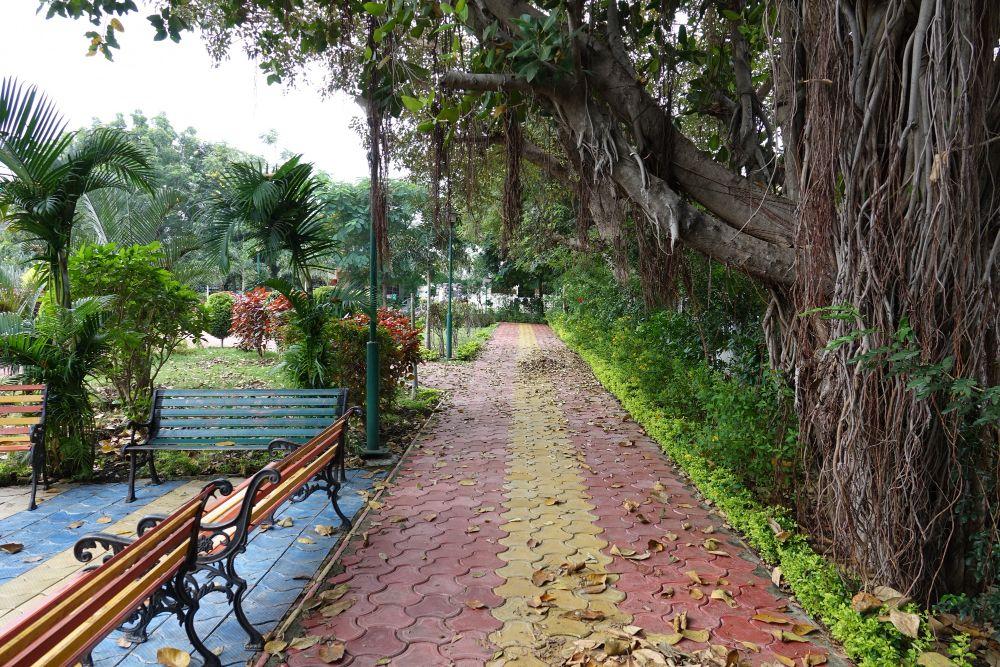
Trees, landscaped areas, and permeable surfaces help moderate local temperatures by reducing heat absorption and providing natural shade.
According to JLL’s reports on residential property value insights, homes situated adjacent to or with direct views of high-quality parks consistently command a quantifiable price premium over identical units lacking such access. Furthermore, Knight Frank’s research on real estate premiumisation trends underscores that master-planned communities with robust green infrastructure exhibit markedly higher absorption rates. Buyers are unequivocally willing to pay more upfront to secure a living environment that structurally mitigates the stress and pollution of the broader city.
For the informed investor, the premium paid for green space is a highly rational capital allocation. Buyers pay more because green infrastructure fundamentally derisks the asset. A property situated within a concrete jungle is highly vulnerable to infrastructural fatigue and shifting market tastes—conversely, a property embedded in a thriving green ecosystem benefits from long-term livability.
This livability ensures demand consistency. Regardless of broader macroeconomic fluctuations, there is always a deep, liquid pool of buyers willing to purchase homes in peaceful, health-oriented communities. Green spaces protect the asset's secondary market value. Investors recognise that while building materials degrade and architectural styles inevitably age, mature trees and established parks only grow more valuable over time. Consequently, nature-integrated developments experience far better liquidity and faster resale velocities.
When developers attempt to leverage the "green" narrative without committing to intelligent design, the financial repercussions are severe. Poorly planned landscapes quickly devolve into costly liabilities. Underused parks, exposed entirely to the harsh afternoon sun or positioned dangerously close to heavy traffic zones, fail to attract residents.
These dead zones require continuous, expensive maintenance—watering, pruning, and security—without generating any corresponding lifestyle or valuation benefit. This tokenism actively destroys value. It drains the Resident Welfare Association’s financial reserves and creates an impression of neglect. Sophisticated buyers easily spot the difference between a functional, thriving ecosystem and a cynical, tick-box exercise in landscape architecture. A poorly executed green space acts as a red flag, signalling deeper flaws in the developer’s overall planning methodology.
The economic and psychological imperatives of green spaces have profound implications for premium plotted developments. In high-rise formats, green space is often restricted to a central podium. Plotted communities, however, possess the acreage required to execute environmental planning at scale.
Intelligent plotted developments are currently transitioning toward much larger landscape-to-built-area ratios. Rather than relying on a single, isolated park, these master plans emphasise open planning and integrated green networks—continuous corridors of nature that connect individual residential plots to larger communal hubs. This design philosophy ensures that every homeowner has immediate, frictionless access to nature. In a plotted township, the landscape is not an isolated destination you visit; it is the continuous medium through which the entire community operates.
Wellness has become the primary driver of the Indian real estate market. The post-pandemic buyer permanently reordered their priorities; proximity to commercial centers and retail strips is no longer enough to command a premium. To sustain high valuations, developments must now fundamentally integrate health and well-being.
Today’s health-conscious buyers are actively auditing a project's environmental integrity before committing capital. The demand for nature-integrated living will only accelerate as urban centres become more chaotic. Developers who treat environmental psychology and landscape architecture as core pillars of their business model will capture premium market segments. Those who continue to treat green space as a secondary, cosmetic feature will face severe pricing pressure and stagnant inventory.
The dichotomy between urban living and natural immersion is finally collapsing. We have reached a point in real estate economics where environmental design and capital appreciation are inextricably linked. Green spaces are not simply areas where construction was paused; they are active environments that lower cortisol levels, foster community, regulate microclimates, and aggressively defend property values
The most valuable real estate of the future will not just be built with superior materials—it will be meticulously planned to support human well-being. At Trident Hills, we understand that true luxury is biological as much as it is architectural. By treating nature as the foundational infrastructure of our communities, we ensure our developments deliver profound daily peace to our residents and uncompromising, long-term value to our investors.
This approach ensures that residents have convenient access to nature throughout the community rather than in a single designated area.
Blogs

A Township Inspired by the Seven Chakras: A Life in Balance
As cities expand and lifestyles accelerate, residential planning is being challenged to balance physical comfort, mental clarity, and social continuity within everyday living.

Trident Parktown: Where Nature, Nurture & Community Unite
A conscious departure from high-density urban living, Trident Parktown is shaped by a three-leaf philosophy that brings nature, nurture, and community together into a balanced way of life.

The Weight of a Promise: Trident Parktown is Now RERA Approved
In the world of real estate, a project begins long before the first brick is laid. It begins with a promise. For the discerning homebuyer, that promise is a complex tapestry woven from architectural vision, lifestyle aspirations, and—most importantly—trust.

PROJECTS
Site Office
Trident Parktown,
Village Nizampur & Azizullapur,
Sector 19A & 40, Panipat, Haryana 132104
Corporate Office
Trident Realty,
16th Floor, DLF Square, DLF Phase-II, Jacaranda Marg
Gurugram-122002, Haryana (India)
© TRIDENT PARKTOWN PVT LIMITED, 2026 All rights reserved
The Developer has availed a construction loan from IndusInd Bank Ltd. (‘IBL’), and has mortgaged project land admeasuring 59.77084 acres and any structures built thereon to such lender, where necessary No Objection Certificates (NOCs) shall be provided by IBL, as per requirement.
Carefully Crafted By

PROJECTS
MEDIA CENTER


Site Office
Trident Parktown, Village Nizampur & Azizullapur, Sector 19A & 40, Panipat, Haryana 132104

Corporate Office
Trident Realty, 16th Floor, DLF Square, DLF Phase-II, Jacaranda Marg Gurugram-122002, Haryana (India)
© TRIDENT PARKTOWN PVT LIMITED, 2026 All rights reserved
The Developer has availed a construction loan from IndusInd Bank Ltd. (‘IBL’), and has mortgaged project land admeasuring 59.77084 acres and any structures built thereon to such lender, where necessary No Objection Certificates (NOCs) shall be provided by IBL, as per requirement.
Carefully Crafted By


